| ||||||||||||||||||
| ||||||||||||||||||
| ||||||||||||||||||
|


| ||||||||||||||||||
| ||||||||||||||||||
| ||||||||||||||||||
|
"My daughter was really offended by your talk last night."
Someone dropped this bomb on me unexpectedly after daily mass this past summer. Although I can sometimes be a bit dicey and bold in my presentations, I was pretty shocked to hear it.
I had given a talk to middle schoolers the night prior on how our faith can help us in managing sadness, anxiety, and stress.
After mass the next day, I was walking in the convention center and was stopped by a woman who asked if I spoke to the middle schoolers the night prior. I responded in the affirmative.
"My daughter was really offended by your talk."
In a flash, I try to recall what I said that might have been the trigger for offense. Nothing came to mind. So I inquired, "Interesting. What was it that bothered her?"
"She said that you told the kids that if you experience anxiety, you can essentially pray it all away. And she has been clinically diagnosed with severe anxiety so it upset her."
"AH okay, I see the misunderstanding here" I ...
In this live recording of a talk, I give a follow-up on my first talk (yesterday's episode!) by breaking down what greatness actually looks like. This includes intentionally shaping our lives around faith, virtue, and service.
Listen to the episode wherever you get your podcasts!
In this live recording of a talk, I give a follow-up on my first talk (yesterday's episode!) by breaking down what greatness actually looks like. This includes intentionally shaping our lives around faith, virtue, and service.
Listen to the episode wherever you get your podcasts!
Every man has this question written on his heart: do I have what it takes?
Do I have what it takes to lead? To provide? To protect those I love most in the face of danger?
To answer yes requires a lot more than a hunch or hope. It’s not one of those things that a participation trophy solves for you. No amount of motherly love and support can make a man ultimately feel good about himself.
But each man wants to wake up full of confidence to shout, with bass in his voice, a resounding YES to that question: I do have what it takes. And if I don’t now, I dream to someday. I want to prove myself, mostly to myself and to the few men I truly respect and admire.
For a long time, we’ve casted this notion as toxic to the male mind. Society determined that this sort of natural unworthiness was not good for men. It cultivates a negative and nasty competitive culture. It creates winners, yes, but it also creates losers, which is a net negative for the community.
So instead, our parents generation sought to create a world full of winners. There was no special prize for first place, but rather an equal prize for all participants. And somehow, we just all felt like losers. Then, the universal winners head out into the real world where, eventually, the nice act of complete parity had faded away.
Young men who have no certainty that they are capable of handling the challenges that lay ahead on the path of duty, responsibility, and leadership were just expected to step into the breach. And many have simply chosen not to. Others tried, but failed. And a select few of us have embraced life head on and have come out victorious, at least so far.
But what is it that made the difference? How does a man learn that he has what it takes to be a good husband, father, and leader in his workplace or community?
What every man seeks is confidence. It’s what we see in the eyes of a Tom Brady when his team is down 3 and he gets the ball back with 2 minutes left. It’s what we see on the TV screen when the action here is gearing up for his final mission. It’s what we recognize in strong political or business leaders in their power suits making impactful decisions.
But how do we build true, lasting confidence? This was a big question for me as a teenager. I reeked of cockiness in my teen years. I was arrogant, especially on the basketball court, but at least it was somewhat deserved there. What’s worse is the level of arrogance I had off the court. I had proven nothing, achieved next to nothing, and my character still left much to be desired.
I wanted to be a confident, capable, and courageous man someday. I yearned to be the type of man others looked up to, came to for advice, and would choose as their leader. I am blessed that God helped me to become that, but it’s important to dissect how it happened.
I recently heard what I think is now my favorite definition of confidence:
Confidence is your reputation with yourself.
The truth is that you can’t control your reputation with other people. Basing your happiness on how others perceive you is a surefire way to end up unhappy. But you are fully in control of your reputation with yourself - for better or for worse.
You know how many times you snooze in the morning. You know what you do when nobody is watching. You know the good and bad things you do on the internet. You know the status of your prayer life, physical health, screen addiction, and more. You know whether or not you’re a man of your word, somebody who does what they say they are going to do.
And that’s why you can’t fake confidence. You can deceive others about who you really are, but you can’t deceive yourself. If you’re insane enough, maybe you can put up with a big gap between those two for some time, but eventually, it catches up to all of us.
Going back to my teenage years, I can remember the participation trophy mentality. I was consistently affirmed for how wonderful I was, even though I knew deep down inside I was locked down in the chains of sin and misery. On the contrary, I’ve been hated and disowned by many of the people who once loved me, while having an immense inner peace knowing I was living a life based in truth and goodness.
The latter was much more satisfying. My confidence was through the roof. That’s how you become bulletproof. It’s how you unburden yourself from a fear of death, fear of failure, and any other fears that hold you back from reaching your full potential.
The first step in building lasting confidence is to recognize the ways in which you are destroying your reputation with yourself. We will talk about step two next week.

So many people want to find deeper meaning in their lives. We have thousands of self-help gurus who will tell you that there are as many easy ways to find purpose and happiness in daily living.
Speak affirmations to yourself in the mirror.
Stop hanging with people who challenge you to be better; instead, pursue those who accept you as you are.
Believe that you are worthy of good things - that karma will have its day so long as you pursue the vague notion of becoming a “good person”.
These are all ideas that sound nice in theory, feel good in practice, and ultimately lead you right back to where you started. That is, of course, unless you are able to practice them with enough fervor that you can achieve self-delusion and narcissism.
For the rest of us, we have to find another path. I think the direction we need is found in this famous quote from Thomas Edison:
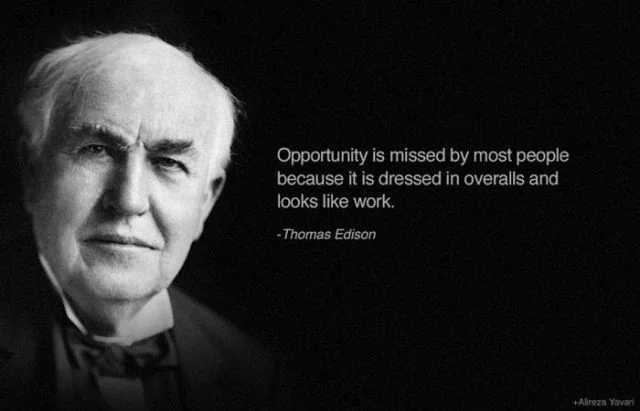
The same is true for purpose. Most people missed it because they think it’s something they can find on an inward-focused journey. They wrongly believe that purpose is something you find or that importance is something you are owed by the world.
This is why you will find young people online with immense levels of entitlement. People will call themselves kings and queens even though they lead no one. We like to crown ourselves with achievement and glory that we have not earned. And who can blame us when we were, as children, given trophies after our losses, which were the same size as those given to the victors?
I’m here to tell you the hard truth today: purpose is not something you find. It is something you create. Perhaps more accurately, it is something you embrace.
For most of us, purpose, fulfillment, and meaning are not some distant far off thing we must discover. Rather, they are constantly in the room with us, waiting us to choose the hard right over the easy wrong.
Do you want to know when I was most empty inside? It’s when I was 15 years old. I was smoking weed nearly every day, sometimes even before school. I quit the basketball team because I had gotten lazy and worse at the game. I was a habitual liar and used the people around me as I pleased.
Do you want to know when I’ve been the most fulfilled? It’s when I’ve been generous with my time and money. It’s when I’ve embraced responsibility in leading my family. It has come from taking ownership of my spiritual, mental, and physical health. It has come from striving for excellence in the workplace and rising in the weight and responsibility I bear on a daily basis.
My emptiness came from a hedonistic life focused exclusively on satisfying my own desires. Deep meaning and purpose have emerged from a life dedicated to serving God and others.
Many young people fail to understand this. They go from place to place looking for what some institution or person has to offer them. They take this mindset to church, to the workplace, and to dating.
Then when they find themselves frustrated and unhappy they blame everyone but the person in the mirror:
“The Church doesn’t care enough about young single people.”
“Corporate life is draining and miserable.”
“The dating world is so hard and unfair and toxic.”
And yet, there is one common denominator in all of this. The world wants you to look inward for purpose and outward for blame. When we are willing to look inward for blame and outward for purpose, things begin to change.
There is one simple question we need to ask to transform our experience in this life. And that is, “how can I help?”
How can I add value here? How can I make someone else’s life and experience better? How can I make this world, this parish, this company, this family, etc., better?
When you pray with this question, your entire perspective begins to change. You no longer show up on Sundays just waiting to receive - from the homily, from the parish offerings, the free donuts. You now show up thinking - I should introduce myself to someone I haven’t seen here before. I should pick up that trash that has fallen to the ground. I should volunteer for that task for which they requested help during announcements.
The same is true in family life. Instead of plopping down on the couch after Thanksgiving dinner, you help wash the dishes. You volunteer to take your cousin to the airport for their early morning flight. You spend a few extra minutes with that great-aunt of yours who speaks somewhat incoherently - not because it pleases you, but because it means a lot to her.
Purpose is not something that is distant and needs to be discovered. It is right in front of you every day. It’s just that it’s dressed in overalls and looks a lot more like hard work than you imagined it would.
According to Investopedia, the real income of a stay-at-home parent exceeds $200,000. But is that based on reality?
For context, my wife stays home full-time with our children. We are very pro-stay-at-home moms around here—that should already be well known.
However, I am very opposed to skewing the numbers to make a financial point. The Investopedia article does precisely that. I have two significant issues with it.
First, it’s simply dishonest (which I’ll explain in a moment) and therefore unhelpful for those trying to decide whether to have a parent stay home full-time.
The second issue is that the article is materialistic in nature, focusing primarily on a financial argument for a decision that is fundamentally human, formative, vocational, and, for many, spiritual. It prioritizes money over the two most valuable aspects of having a stay-at-home parent, both of which are priceless.
Let’s address the dishonesty first. As you can see in the screenshot below, the article accurately assigns national average costs to the general work done by a stay-at-home parent.
This part is true: that's what you'd pay individuals to do those tasks. The problem, though, is that only the top 1% of society actually hires people to do that work. My wife doesn’t save us money by doing our laundry, cooking our meals, cleaning the house, or driving the kids around.
Why? Because if we both worked, we wouldn’t pay anyone to do those things. In most dual-income households, people end up doing all that work ON TOP OF their full-time jobs. Full-time working and parenting is an absolute grind, there’s no doubt about it.
My wife does save us money on childcare, but it doesn’t come anywhere near $130k per year for two children, unless I were hiring private trilingual tutors at the highest end of the cost spectrum.
Some two-income households have family members watch their children or other arrangements that cost $1,000 a month or less, so the $130k price tag to cover 14 hours of childcare per day is just absurd.
Now, I understand why people do this. It’s an extreme reaction to society’s growing distaste for traditional family values. When the world rejects the value of motherhood, we try to amplify it using the one measure the world respects most: money.
But money isn’t the best way to measure the value of the stay-at-home parent lifestyle and their contribution to the family. My wife would be the first to tell you that the most valuable part is the extra time she gets to spend with our kids.
By the time our children are 5, Emily will have had almost an extra 10,000 hours with them that she'd otherwise have missed out on. That has a massive impact on their character formation, familial bond, and education.
What’s in it for me, the provider? Besides the satisfaction of those extra 10,000 hours for my wife and kids, it’s the massive increase in leisure time I get because someone is managing the home full-time.
No, this doesn't mean I never help out around the house. But I don’t have to split cooking meals, doing laundry, and many other chores because she handles the majority of them while I’m working.
Then, when I come home, I'm able to enjoy the meal she's prepared and take over the kids for a couple of hours before we tag-team bedtime. I get to play with the kids every evening instead of washing dishes or cleaning the house. It’s a win-win: she gets her much-needed break from the children, and I get my precious time with
them.
That said, becoming a one-income household is definitely a financial decision. The problem with Investopedia’s math is that it distorts the financial bar of entry.
Most approach the financial
aspect of one parent leaving their job
through a simple equation: